The Lost River That Returned to the Stage
The Lost River That Returned to the Stage
By Sohail Sangi
On the 18th day of the World Culture Festival 2025, the Arts Council of Pakistan Karachi turned into a confluence of theatre, film, music and fine art. But among the day’s offerings, it was the Urdu tragedy The Dead River that gripped audiences most deeply—an evocative exploration of memory, ecology and forgotten histories.
Directed by noted theatre practitioner Shahnawaz Bhatti, the production drew a full house. Among the attendees was Sindh Education Minister Syed Sardar Ali Shah, renowned writer Noorul Huda Shah who called the festival “a powerful response to rising extremism” and praised the Arts Council for opening cultural spaces to international dialogue.
Reviving a River Buried by Time
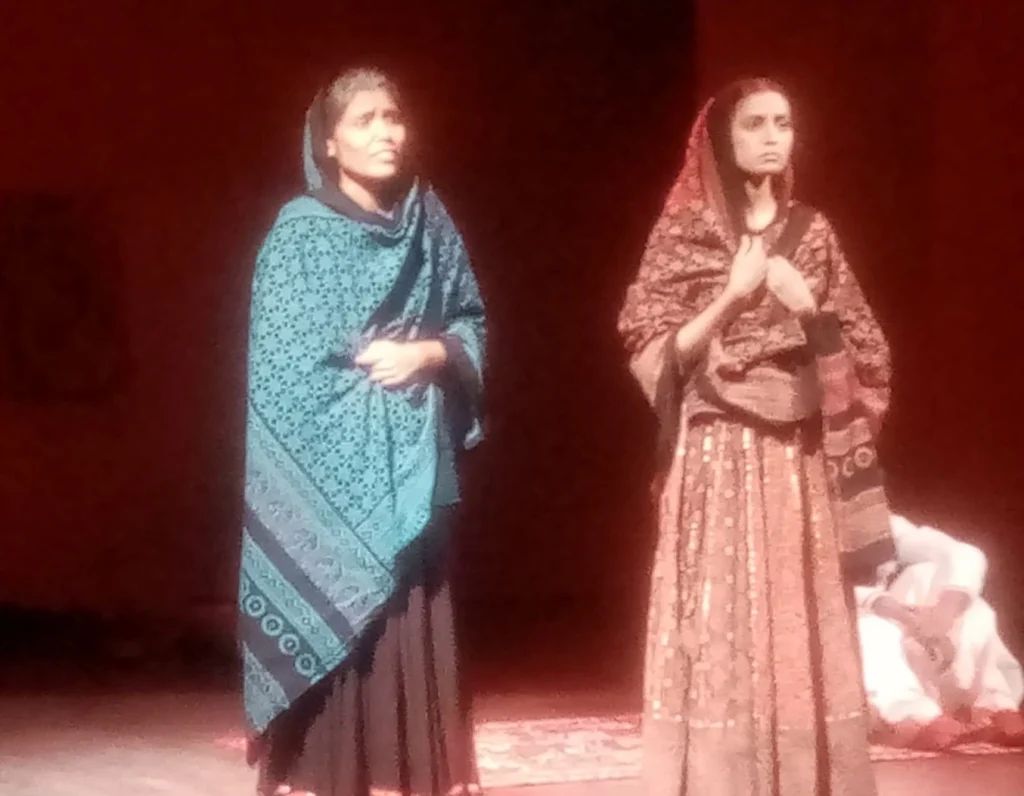
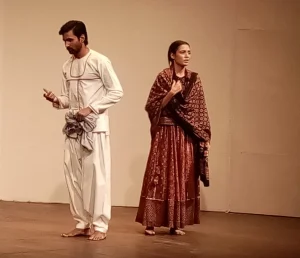
Adapted from Abdul Qadir Junejo’s novel, The Dead River resurrects the lost story of the ancient Sindhi river Hakro, once known as Saraswati and Gaggar. Onstage, Bhatti transforms the river into a living presence—a character that breathes, mourns, remembers.
The story probes the region’s environmental and historical fractures. Speaking about its themes, Shah noted how colonial interventions disrupted natural water systems.
“It was the British who first blocked the natural routes of these rivers, and that is why the region continued to suffer,” he said.
For him, the play’s strength lay in its ability to connect these historical ruptures with present-day realities. “It was an excellent performance—the director successfully linked past and present.”
Characters Carved by Water
The narrative spans generations. Characters Sukhan, Ambaram, and Janu appear in both their younger and older selves, showing how entire communities bend, break, or disappear with the river’s flow—or its absence.
Actors Zubair Baloch, Yasmeen Usman, Mati Mukhtalif, Tooba Naeem, Omeed Akbar, and Ali Bakhsh earned repeated applause for breathing urgency and tenderness into these roles. Their performances made the dried riverbed feel haunted with footfalls, whispers, and centuries of longing.
The Message Beneath the Performance
Speaking to The Express Tribune, Bhatti explained that the play aims to illuminate the intricate bond between nature, culture and society.
“What is the value of water? Rivers must flow naturally,” he said. “When you block a river—whether it’s Sutlej, Ravi or Chenab—you disrupt a system that was never meant to be interrupted. A river always knows its path.”
He pointed out that the play touches political history—from colonial engineering to post-Partition treaties that reshaped water distribution. “The impact wasn’t limited to one river; it affected all of Pakistan.”
When Art Becomes Witness
For Bhatti, the theatre is not merely a stage—it is a social conscience.
“Theatre isn’t just entertainment. Even if society doesn’t change overnight, art should make people think. The water crisis still exists—it’s getting worse.”
The director’s personal connection to the story gives his work emotional weight. Growing up in Umerkot, he witnessed firsthand how the shifting of natural waterways turned fertile land into dry stretches.
“The water that nourished our lands moved towards Rajasthan. Entire areas dried up. This crisis is real for our people,” he said.
Culture as an Act of Preservation
For Bhatti, cultural work is a form of duty.
“Art gives us a way to explain the world. It helps us communicate positive messages and remind people of their heritage.”
At the Arts Council that evening, The Dead River did more than retell a forgotten chapter of Sindh—it invited audiences to confront the cost of ecological neglect and the fragility of cultural memory. As applause filled the hall, it was clear that a river long lost in history had found new life in art.