Rs500 million allocated for each constituency, Murad concludes debate on the budget
Sindh Assembly passes Rs3.45 trillion budget for financial year 2025-26,
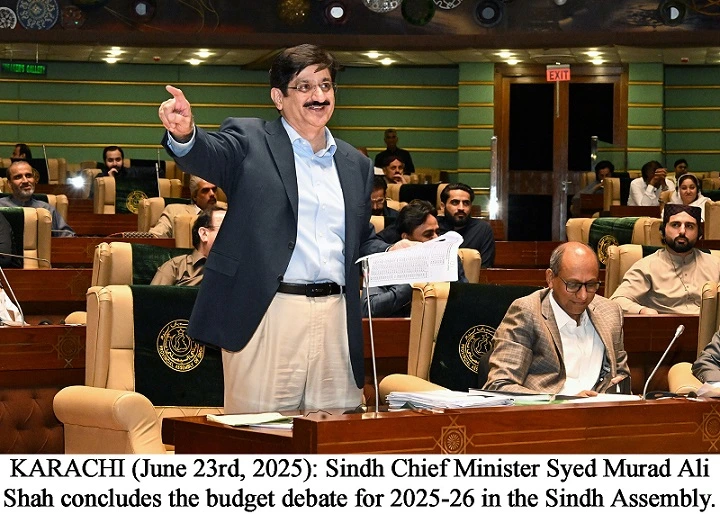
KARACHI (June 23): Sindh Chief Minister Syed Murad Ali Shah, concluding debate on the budget 2025-26, delivered a comprehensive address in the Sindh Assembly, said that although his party had the absolute majority to pass the budget independently, they had chosen to work inclusively. “We could have bulldozed all rules if we wanted to, but that is not our way. We want to move forward together.”
Mr Shah pointed out that the ongoing budget discussion had seen extensive participation. “I am the 135th member to speak on the budget – this kind of debate has never taken place before,” he noted. “Last year, 132 members participated in the debate, and this year, more than 42 hours of discussion have already taken place.”
The CM also responded to criticism, suggesting that Sindh lacks democratic practice. “Let me present the facts,” he said. “In the Sindh Assembly, 100 per cent of opposition members have spoken. In Khyber Pakhtunkhwa, only 53 out of 145 members have spoken, and their debate has already concluded.”
“In the National Assembly, 204 out of 336 members have spoken about 60 per cent. In Punjab, with 371 members, only 46 have spoken so far, which is just 12.5pc. Even if four times that number speaks, it still won’t reach 50pc,” he explained. “In Balochistan, 12 out of 53 members have spoken, and they still have three or four days left.”
“Despite these facts, people say democracy doesn’t exist in Sindh,” the CM said. “In 1947, we welcomed people here-and we still do today. And if someone wants to leave, the Constitution gives them that right. But I won’t say go- I believe Sindh is the best province in Pakistan.”
Murad Shah highlighted that the province’s development budget constitutes approximately 30 pc of the total budget, surpassing Punjab’s 23 pc and Khyber Pakhtunkhwa’s 25.3 per cent. While he acknowledged that Balochistan has a higher development budget, he noted that it is also governed by the PPP.
The CM pointed out that the federal government initially promised Rs1.9 trillion for the year but subsequently revised it to Rs1.796 trillion, resulting in a shortfall of Rs100 billion. He expressed concern over the low revenue collection thus far and urged the federal government to release at least Rs237 billion.
Despite the federal government collecting 13 per cent more in taxes, the CM stated that Sindh’s revenue growth outpaces it, with a 16 pc increase in provincial collections. He outlined the revenue targets for the upcoming budget, emphasising the need for equitable tax rates across the province, from Karachi to rural areas like Dadu.
Agri Tax: Murad Shah also addressed the agricultural income tax, noting that the erroneous tax policies may lead to wheat imports this year. The CM announced a target of Rs8 billion for agricultural tax next year, equating to a tax of Rs1052 per acre. He contrasted this with Punjab’s target of Rs 372 per acre and Khyber Pakhtunkhwa’s target of only Rs 57 per acre for their cultivated land.
CM Shah’s remarks reflect the ongoing fiscal challenges and the need for balanced resource allocation across the provinces.
Key Initiatives: The chief minister unveiled a series of significant initiatives aimed at bolstering development across various sectors in Sindh for the upcoming year.
Among the highlights, the government aims to achieve 100 per cent birth registration, ensuring that every citizen is accounted for from the outset of their lives.
Murad Shah also noted that measures for agricultural development have already been outlined by the Minister of Agriculture, reflecting a commitment to enhance the province’s agricultural output.
In the education sector, the establishment of cost centres has been initiated, aimed at improving resource allocation and management within educational institutions. Furthermore, funding for the department supporting individuals with disabilities has been increased, demonstrating a commitment to inclusivity.
The government plans to expand autism centres and other related departments to better serve the needs of affected individuals and their families. In addition, Youth Development Centres are being established across all districts, with 19 already operational, aiming to provide young people with essential services and support.
The Sindh Institute of Child Health boasts the largest child emergency network globally, and a new Sindh Institute of Urology and Transplantation is under construction in Larkana, emphasising the government’s focus on healthcare infrastructure.
The Chief Minister also announced the procurement of new ambulances and specific programmes designed to support fishermen in the province.
Financial support for universities has been enhanced, alongside increased funding for solid waste management initiatives in Sindh.
In terms of fiscal policy, salaries have been raised by 10 to 12 per cent, while pensions have seen an increase of 8 per cent. Moreover, the government has abolished professional and entertainment taxes, as well as reduced various vehicle taxes, including those applicable to larger vehicles.
Finally, the provincial Annual Development Programme is set at Rs 10820 billion, underscoring the government’s commitment to advancing infrastructure and public services in Sindh. [The ADP for year 2025–26 has been set at Rs 520 billion. In addition to the District ADP Rs 55 billion, Foreign Project Assistance (FPA): Rs 366.72 billion and Federal PSDP contributions: Rs 76.28 billion.
Depts being looked after by the CM: Murad Shah asserted that he listens to 90 per cent of the speeches from assembly members. He suggested that there may have been a targeted agenda against him, stating, “It was implied that only 11 departments belong to the CM; however, I oversee 45 departments.”
The Chief Minister contrasted his responsibilities with those of other provincial leaders, noting that the Chief Minister of Punjab manages 14 departments and that of Balochistan oversees 20.
Sindh’s territorial integrity: He remarked on the historical claims to Sindh’s territorial integrity, recalling that the first map of Sindh depicted regions including Makran and Rajasthan.
CM Shah discussed the historical evolution of Sindh, stating that during the Kalhora period, the capital was initially in Khudabad before being moved to Hyderabad. He mentioned that the Talpur dynasty later divided Sindh into three parts, yet maintained a unified approach to defence and diplomacy.
He recounted the British conquest of Sindh, highlighting Charles Napier’s desire for Sindh to remain unified, while criticising the subsequent decisions made by the new Viceroy to integrate Sindh into Bombay.
The CM reflected on the local resistance against these decisions, asserting that Sindh’s people successfully thwarted attempts to merge Sindh with Punjab. He praised early political figures from Sindh, such as Ghulam Ahmed Bhurgri and Sir Shahnawaz Bhutto, for their roles in advocating for Sindh’s separation from Bombay and their contributions to the Pakistan Movement.
He noted that the All India Muslim League’s Sindh chapter was instrumental in the push for a separate homeland for Muslims, culminating in the recognition of Sindh as a province in 1936. The CM concluded by acknowledging the historical significance of the 1940 Pakistan Resolution, which originated from Sindh, and reaffirmed the legacy of the 24 members who supported the resolution, whose descendants remain active in Sindh’s political landscape.
Historical Contributions and Current Political Dynamics: Chief Minister Murad Ali Shah remarked that the descendants of key figures who played pivotal roles in the establishment of Pakistan are currently part of the Pakistan Peoples Party. He asserted that the Sindh Assembly was the first to declare independence, urging attendees to take pride in their heritage while also acknowledging historical facts.
During his address, the CM presented photographs of pre-1947 Karachi, countering claims that the city was devoid of development after independence. He stated that Karachi was on the rise in 1947, which prompted Quaid-e-Azam to designate it as the capital.
In response to a suggestion from a member regarding a resolution against Israeli attacks on Iran, the CM proposed a legal solution to address the matter after the budget speech. Although there was initial agreement, protests ensued. Murad Shah noted that the protests appeared premeditated, with banners prepared in advance.
The opposition raised concerns that their schemes were not included in the budget.
The Chief Minister invited the opposition to submit their proposals in writing, which they did, with 17 members providing schemes along with their costs.
A decision was made to incorporate constituency-specific schemes, with an assurance that no single member’s scheme would be excluded. He sought the opposition leader’s assistance against federal injustices, asserting that the federal government was using the opposition as a means to further its agenda.
The CM mentioned that the federal government had established a federal agency for the Green Line project in Karachi, which was also supported by the Pakistan Tehreek-e-Insaf party. He expressed concerns about this arrangement and highlighted a promise made by former Prime Minister Nawaz Sharif to discontinue such practices.
In the recent budget documents, schemes for all provinces were included, except for Sindh, which only had its projects assigned to the Pakistan Industrial Development Corporation Limited (PIDC). The CM called upon the opposition leader to assist in rectifying this disparity.
Ultimately, the federal government has now allocated three major schemes to Sindh, indicating a shift in the political landscape and a potential path forward for collaborative governance.
Budget Allocations: CM Murad Ali Shah stated that he is not alone in addressing the grievances within the assembly, as members of the Muttahida Qaumi Movement (MQM) are also participating in protests. He noted that MQM members have expressed the necessity of collaboration with the Sindh government for effective governance.
Rs500 million allocated for each constituency
Mr Shah emphasised that the mandate does not allow a federal company to operate in Sindh without the provincial government’s consent. He affirmed that Rs500 million has been allocated for each constituency, with members required to propose schemes within this budget.
Several proposals have already been implemented, and he highlighted that Karachi has been overlooked in budget discussions.
He pointed out that out of a total of Rs1,400 billion, only Rs 60 billion, representing 4.6%, has been allocated to Karachi, while a total of Rs 254 billion has been earmarked for the city, with the possibility of further increases. However, projects such as Bhutto Avenue and the M-9 Link Road were not included in the budget.
Rs12 billion for Karachi,
The Chief Minister addressed misconceptions circulated by the media regarding the absence of mega projects for Karachi, clarifying that Rs12 billion has been reserved for such schemes, which encompass projects across the city. He refuted claims that only schemes for Lyari and Malir were included, asserting that all proposals are available for scrutiny.
He elaborated on the challenges faced by Karachi in terms of financial independence, contrasting it with other metropolitan areas that retain a significant portion of their revenue.
The CM mentioned that legal obstacles hinder Karachi’s ability to secure necessary funding.
Plans for 20 million homes underway
In a notable achievement, the CM reported that plans for 20 million homes are underway, with 12 million currently under construction and 6 million completed. Furthermore, women have been granted ownership rights to these homes, ensuring empowerment alongside housing provision.
Autism centres in Karachi
The Chief Minister provided updates on autism centres in Karachi and other cities, stating that three centres are nearing completion. He recounted the history of the K-4 project, which has seen escalating costs from Rs 25 billion to Rs 175 billion due to federal inquiries and delays.
Minimum Wage: In terms of minimum wage, the current rate in Sindh stands at Rs 37,000, with proposals from Punjab and Khyber Pakhtunkhwa advocating for an increase to Rs 40,000. The CM argued for a minimum wage of Rs 42,000 to better support workers.
Judicial Allowance: The assembly has allocated Rs 8 billion for a special judicial allowance, with discussions on salary increases for judicial staff to be determined by the assembly. The CM highlighted the disparity in salaries, noting that a judge’s income exceeds Rs2.2 million after tax deductions, while the speaker of the assembly earns merely 10 per cent of that amount.
Procedural matters: Murad Shah addressed the assembly regarding procedural issues and the recent budget session. He explained that a resolution was not passed in the first session but was successfully approved in a subsequent meeting, stating, “The budget session concluded, yet disorder continued.”
The Chief Minister addressed criticisms regarding provincial debt, affirming that Sindh is the only province with sound financial management, which attracts substantial loans from international institutions. He clarified that the budget allocation of Rs12 billion for flood relief pertains to recovery from the 2022 floods, not for new calamities.
“India has propagated the notion that Pakistan is in ruins, and I urge our members not to echo such sentiments,” he cautioned, stressing the importance of unity against external narratives.
Mr Shah reported that Sindh is on track to complete 1,460 schemes this year, setting a record, and encouraged members to propose larger projects rather than smaller ones to make a more significant impact. He acknowledged that while some schemes have faced delays, efforts are underway to complete all ongoing projects.
The chief minister emphasised the necessity of collaboration for the province’s development and thanked members from both sides for their patience in listening to him. He also acknowledged the Speaker and their team for effectively managing the assembly’s proceedings.
The session of the Sindh Assembly has been adjourned until tomorrow.