Reclaiming the Lost History
Karoonjhar - Masoom Thari
By Ayoob Khoso
Whenever we think about the history of Sindh, a dismembered and mutilated body seems to loom over us. A peaceful nation, which laid the foundation of a beautiful civilization, adorned itself like a bride of its time, nurtured prosperity, gave life to thought and art, but then suddenly faced natural calamities, struggled to recover, only to be invaded by savage tribes and forces, leading to the devastation of everything. People may have travelled thousands of kilometers in search of refuge, and much may have changed in the aftermath.
This is the reality of the homeland of Sindh, nothing else. The tragic wounds of partition have plunged Sindh’s history into such darkness that it cannot be described in words. It happened that an illogical partition was imposed on the neck of Sindh. It should have been that the British, who invaded and occupied Sindh, ending the rule of the Talpurs, would have returned Sindh along with its map, but that did not happen, only sorrow remained. Almost half of Sindh was handed over to India, and the rest of Sindh, which was given to the rulers, was shaped under their specific religious ideologies, closing the doors of history. The great betrayal was committed by British researchers, who not only distorted the history of Sindh but also turned the history that belonged to Sindh towards Indian history.
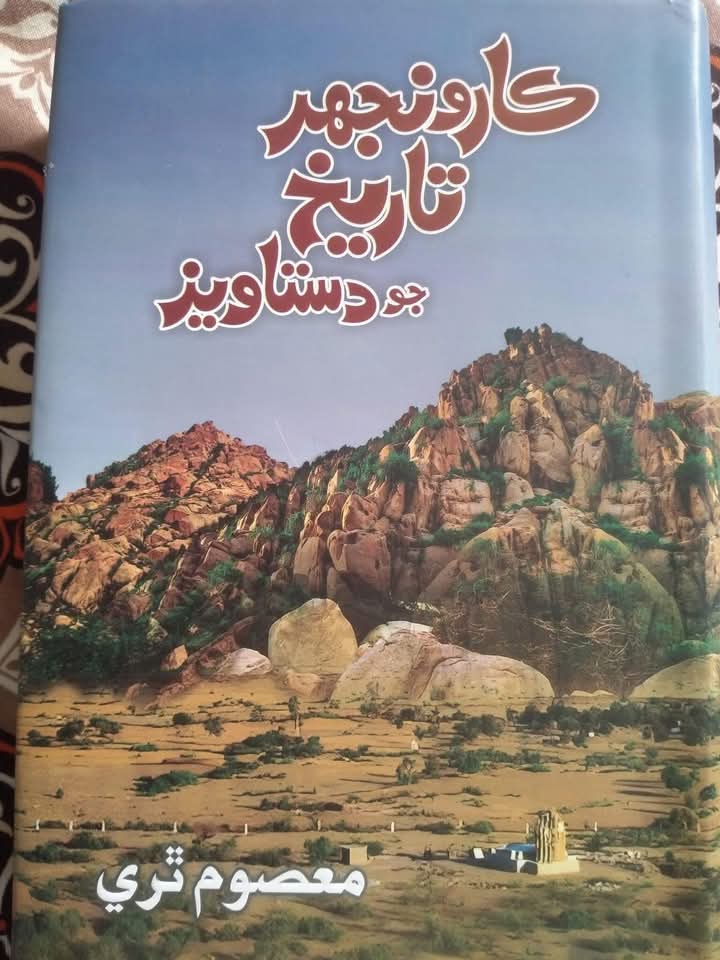
Our extremely talented writer and researcher, Masoom Thari, with his open mind and heart, has taken the responsibility to bring the history, which has been turned upside down, back on the right track. Without supporting any specific ideology, with unparalleled references and studies, he has brought forth the book “Karoonjhar: A Document of History” to the public, which is undoubtedly a complete and masterpiece effort. Some books are written in a state of ecstasy and become memorable.
This book is also a part of that beautiful truth. In Sindh, our scholars like Bherumal Meharchand Advani, M.H. Panhwar, Yusuf Shahin, and Ata Muhammad Bhambhro, who have tried to bring the real history of Sindh on the right path, have the same enlightened perspective as Masoom Thari. This book is a magnificent and lively study, which not only highlights new research but also opens new avenues for discussion, and along with that, it shows the way for the Department of Archaeology to open new doors of exploration. Let us reclaim our lost great history by re-establishing the ownership of the places and cities of our glorious past. This research-based historical book has been adapted with modern scientific foundations and has also benefited from many important reference books.
This is the first time that the ancient ruins spread over several kilometers in the Karoonjhar Mountains of Nagarparkar, which are thousands of years old, these river valleys and ancient cities that exist in the form of ruins or are buried in the Rann of Kutch. The ancient trading centers and status-holding cities have been illuminated through ancient religious texts, the Rigveda, Jain, Buddhist texts, Parsi texts like Zend Avesta, and the historical writings of Greek, Iranian, Arab, English, Chinese, and European scholars and researchers, and have been verified with historical references. The vast southern part of Sindh, which includes the great Rann of Tharparkar and Kutch, has been the soul of Sindh’s ancient cultural history, where magnificent cities flourished.
This was a bouquet of great traditions, tolerance, and religions. The history of this entire region or province is lost or turned upside down. Masoom Thari has taken the lead in resolving this entire tangled thread and bringing the ignored truth to light. It has also come to light in this research which tribes and castes are associated with Sindh, who nurtured Sindhi civilization. Who wrote the Rigveda? What is the lineage of the Aryans? The ancient city of Paataal is in Parkar, and the evidence of its existence is extremely strong. Which Sindhi migrations reached Iran, Greece, Afghanistan, and Sri Lanka? Under what circumstances did the courses of the Sindhu and Hakra rivers change? How were new cities built? Which warrior tribes of Sindh held sway? All this has become the new history of this book. Many new revelations that this book offers us are groundbreaking. An important thing is that the book has achieved a perfect continuity.
Professor Dr. Riaz Shaikh, in the beautiful preface of this book, writes that the state based on religious ideology decided to start its roots from the invasion of Muhammad bin Qasim in 712 AD and ignored the things before that. Due to this thinking, the areas that were ignored include Tharparkar. There is no doubt about this fact, as a result of which a historical treasure has become a victim of neglect. The brave researcher Masoom Thari has given new life to the hidden thousands of years old history of Tharparkar.
In this book, the historical wells of Viravah, Gori Temple, Dongri, Kasbo, the courses of the Hakra and Sakhi rivers, the city buried in the Kanbhat Nar, the foundation of Thar, Kakarali, Luni River, Kantho, Rann of Kutch, the disappearance of Bakhasar, the different government periods over Sindh, ancient Rigvedic verses, Puran, Sokat, the invasions of Alexander the Great, and detailed research about the life of various things have been presented.
Great poet Shah Latif, in his poetry, described the ancient geography of Sindh, and the ancient parts and cities of Sindh that were lost or handed over to India, Masoom Thari has traced them in this research book. This research reveals to us that the Rigveda is the first written book of Sindh. The Aryans were not outsiders but people who, based on religious ignorance, plundered the civilization and prosperity of Sindh and then went to settle in the snowy region of Meru Parbat, and after five hundred years, along with some people from there, came back and occupied Sindh. The ancient name of Thar is Marusthal, and the ancient name of Karoonjhar is Pariya-tar. The ancient city of Badrisar in Parkari Sindh is now called Bhodesar. “Bhalo” is the invention of Sindhi Bhils. This research clearly shows that the world’s first secular constitution was given by the Sindhis.
This Sindhi empire was overshadowed and fell into decline, which was very magnificent. The vast empire of the famous Emperor Chandragupta Maurya extended up to Tharparkar. The ancient Indian poet Bhartri Hri was also associated with Sindh, who is buried in Sehwan. The annual Mela of Chandar Maurya is still held near Mirpurkhas in Sindh, near Saman village. There is an ancient cemetery there, where Chandar Maurya is buried. This village is also named after Chandar Maurya.
The research in this book tells us that the Kambojas, Pahlavas, Sakas, Yavanas, and Pravas were the ancient Sindhi warriors who protected Sindh. Swarisika is the national symbol of ancient Sindhu civilization. These original Sindhis, who resisted foreign invaders, were labeled as Shudra, Daitya, Danu Malich, just as today in our country every national lover is called a traitor.
The truth is that Masoom Thari, through this courageous research, has not only immersed himself in highlighting the real history of Sindh but has also boldly revealed much of the lost or buried history. It is believed that this book will prove to be an important guide in the future regarding the history of Sindh.