Professional Development of Teachers Needs Effective Monitoring

Professional Development of Teachers - By: Daniyal Nuqrich
By: Daniyal Nuqrich
Professional development is a lifelong process through which teachers refine their teaching practices, expand their knowledge, and keep pace with the fast-changing demands of today’s world. As every profession evolves, so must the role of a teacher. Even small businesses such as puncture repair shops have modernized their work—yet many teaching practices remain outdated. In an age where students are actively using Artificial Intelligence tools, the inability of teachers to operate a basic laptop raises serious concerns about the future of learning.
Over the past few years, the School Education and Literacy Department (SELD) has recruited around 50,000 Primary and Junior Elementary School Teachers across Sindh. Every newly appointed teacher underwent a mandatory 26-day induction training, covering lesson planning, foundational teaching theories, classroom management and teaching styles. The programme included pre- and post-assessments and concluded with a reflective assignment summarizing their learning. The training, introduced by the Government of Sindh in collaboration with STEDA—which now issues teaching licences—was expected to prepare teachers for effective classroom performance.
According to data obtained from the District Education Office Umerkot, 1,600 Primary School Teachers, 800 Junior Elementary School Teachers, and 60 Subject Specialists have completed this initial training so far.
A Series of Trainings — But Little Coordination
To further enhance skills, the department has sent teachers to various external trainings offered by NGOs and partner organizations, covering a wide range of social and educational themes.
-
Life Skills–Based Education: Around 500 Junior Elementary School Teachers have participated in phased training sessions on life skills.
-
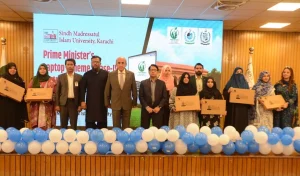
Education in Emergencies & ICT Integration: A 12-day ICT and AI-based training, funded by the World Bank and conducted by PITE, introduced teachers to digital tools such as AI-generated lesson planning, Storybird, Canva and Gamma. Participants practiced basic computer operations and MS Office in E-Labs, and the programme even drew a visit from the provincial education minister.
Yet, a key question remains: Are schools sufficiently equipped for teachers to apply these digital skills? -
SMC Utilization and DRR: Teachers were trained on School Management Committees, fund utilization and community engagement.
-
Early Childhood Education: UNICEF-funded sessions conducted by TRDP focused on teaching strategies for early grades. While ECE material was supplied to schools, reports indicate much of it remains unused—often locked away by head teachers.
-
Understanding Child Psychology: A three-day workshop helped teachers understand children’s social and psychological challenges, appropriate teacher–student boundaries, and methods to support struggling learners.
-
Multi-Grade Teaching: Community World Service Asia (CWSA) trained teachers to manage multi-grade classrooms—an issue commonly faced in primary schools.
Where is the Monitoring?
Despite significant investment in teacher development, the biggest gap lies in implementation monitoring. Many partner organizations conduct follow-up field visits, yet seldom share comprehensive implementation reports with district authorities. Meanwhile, the education department’s monitoring wings remain largely focused on teacher and student attendance—not classroom performance or the practical application of new teaching techniques.
Secretary Education can assign dedicated tasks to district officers and the Reform Support Unit to evaluate how effectively teachers are translating training into classroom practice. Without systematic follow-up, even the best training programmes fail to bring meaningful change.
The Need for Self-Realization
Beyond structural reforms, teachers themselves must embrace professional responsibility. Despite economic challenges, the government continues to invest in their growth. Teachers owe it to their students—and to society—to apply what they learn with sincerity and commitment. Professional development should not be viewed as a formality, but as a moral obligation that enhances personal satisfaction and contributes to the collective educational future of Sindh.