Pakistan to enhance water storage amid India’s Indus Treaty actions: PM Shehbaz

Pakistan to enhance water storage amid India’s Indus Treaty actions: PM Shehbaz
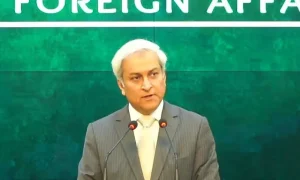
ISLAMABAD, July 1 — Prime Minister Shehbaz Sharif announced on Tuesday that Pakistan will significantly enhance its water storage capacity in response to what he described as India’s attempts to “weaponise water” by undermining the Indus Waters Treaty (IWT).
Speaking during a visit to the National Emergencies Operations Centre, the prime minister said the government’s decision follows New Delhi’s suspension of the decades-old treaty in April after a deadly attack in Indian-administered Kashmir. India blamed Pakistan for the assault in Pahalgam, which killed 26 people, though it presented no evidence.
visit to the National Emergencies Operations Centre
PM Shehbaz Sharif Visits National Emergencies Operations Centre | 01-07-2025 | PTV News
The Indus Waters Treaty, signed in 1960, divides the six rivers of the Indus Basin between the two countries. While India controls the eastern rivers — Ravi, Beas, and Sutlej — Pakistan receives about 80% of the waters from the western rivers — Indus, Jhelum, and Chenab.
Islamabad has condemned India’s move to hold the treaty “in abeyance,” calling it an “act of war” and a violation of international law. Pakistan is reportedly considering legal recourse under the 1969 Vienna Convention on the Law of Treaties. The Permanent Court of Arbitration (PCA) in The Hague has also ruled that India cannot unilaterally suspend the IWT.
Citing the PCA’s decision, PM Shehbaz said India had no authority to act alone on the treaty, warning of “hostile designs” against Pakistan’s water rights. “In response, we have decided to build our water storage capacity,” he stated.
He said the government would prioritise the construction of “non-controversial” water storage projects, including the Diamer Bhasha Dam, using domestic resources. Referring to the 1991 inter-provincial water accord, he noted that there is a clear mandate to expand storage infrastructure.
“This is a national imperative, and the National Disaster Management Authority (NDMA) will play a key role in implementing this strategy,” the prime minister added.