China Calls for Global Consensus on Balancing AI Development and Security
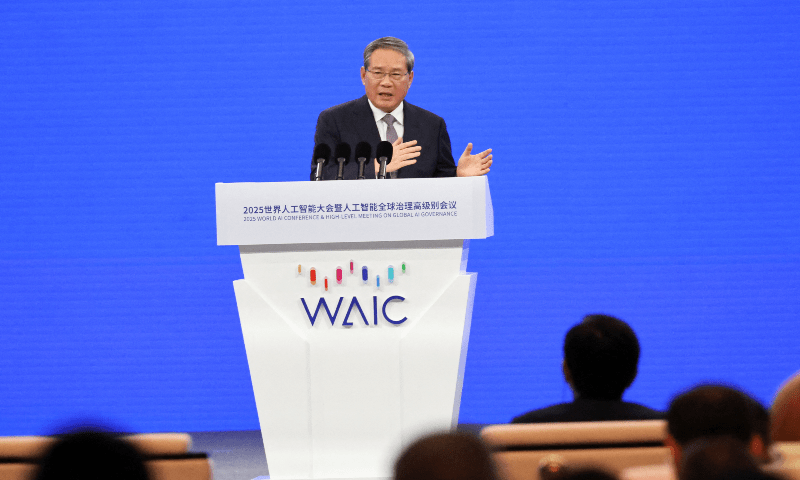
China’s premier Li Qiang

China Calls for Global Consensus on Balancing AI Development and Security

SHANGHAI: Chinese Premier Li Qiang on Saturday urged the international community to build a global consensus on balancing artificial intelligence (AI) development with security, warning of growing risks as the tech race between Beijing and Washington intensifies.

Speaking at the opening ceremony of the World AI Conference (WAIC) in Shanghai, Li emphasized the need for international cooperation, governance, and open-source development. He announced the creation of a Chinese-led body for global AI collaboration.

“The risks and challenges brought by artificial intelligence have drawn widespread attention. How to find a balance between development and security urgently requires further consensus from the entire society,” Li said. He added that China would “actively promote” open-source AI and share its technological advancements, particularly with developing countries.

Li cautioned against monopolies and restrictions in AI development. “If we engage in technological monopolies, controls and blockage, artificial intelligence will become the preserve of a few countries and a few enterprises,” he noted.

The premier highlighted the shortage of computing power and advanced chips as a major bottleneck, pointing to Washington’s recent restrictions on chip exports to China. The United States, under President Donald Trump’s new low-regulation AI strategy, has pledged to “remove red tape” to bolster private-sector innovation.

China, on the other hand, has declared AI a key component of its tech self-reliance plans. In January, Chinese startup DeepSeek unveiled an AI model that matched the performance of leading US systems despite using less advanced chips.

The WAIC event also spotlighted ethical concerns surrounding AI. Nobel laureate physicist Geoffrey Hinton likened the technology to keeping “a very cute tiger cub as a pet,” warning that humanity must ensure AI is controlled as it evolves.

In a video message, UN Secretary-General Antonio Guterres called AI governance “a defining test of international cooperation.” French AI envoy Anne Bouverot also stressed the “urgent need” for a unified global framework.

While 58 nations, including China, France, and India, endorsed stronger coordination on AI governance during a Paris summit in February, the US and the UK refused to sign the declaration, warning against what they called “excessive regulation” of the technology.

WP2Social Auto Publish Powered By : XYZScripts.com