Politics Overshadow Asia Cup Glory as India Shuns Trophy Ceremony
Politics Overshadow Asia Cup Glory as India Shuns Trophy Ceremony
The men’s Asia Cup ended in controversy on Sunday as India’s cricket team refused to accept the winners’ trophy from Asian Cricket Council (ACC) chief Mohsin Naqvi, highlighting once again how politics continues to overshadow sport between the two neighbors.
India had clinched their ninth Asia Cup title with a nail-biting five-wicket victory over Pakistan, but the celebrations were overshadowed by a prolonged delay during the presentation ceremony. The Indian players remained firm in their stance, refusing to take the trophy from Naqvi—who also serves as Pakistan’s Interior Minister.
The tension had been simmering long before the final. Indian captain Suryakumar Yadav had already skipped the customary pre-toss photoshoot, fueling speculation of a boycott. After the match, there were no handshakes between the two teams, reflecting the strained relations from earlier encounters in the tournament that were marred by political posturing and aggressive behavior.
Simon Doull, who hosted the presentation, confirmed: “I have been informed by the ACC that the Indian cricket team will not be collecting their awards tonight.” While some Indian players did collect individual awards, the captain declined to respond to questions about politicizing the game at the post-match press conference.
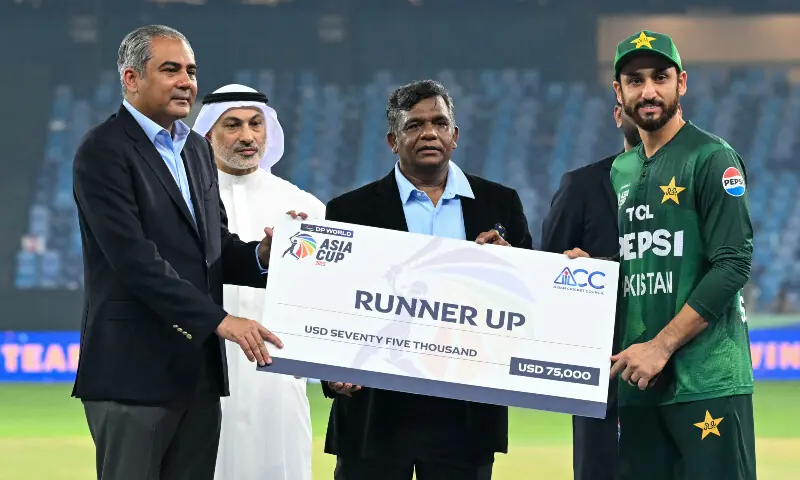
Pakistan’s skipper Salman Ali Agha received the runners-up trophy in a subdued ceremony.
The refusal marked a new low in the cricketing ties between India and Pakistan, countries that have often used cricket as a stage for diplomacy. This time, however, the rift deepened as Indian Prime Minister Narendra Modi weighed in with a politically charged statement on X: “Operation Sindoor on the game’s field. Outcome is the same — India wins! Congrats to our cricketers.”
Pakistan responded swiftly. On Monday, ACC chief Mohsin Naqvi rebuked India for “dragging war” into cricket, calling it a sign of “desperation.” Referencing the May military conflict, he added: “If war was your measure of pride, history already records your humiliating defeats at Pakistan’s hands. No cricket match can rewrite that truth.”
The match itself had been a thriller. Pakistan, after a promising 84-run opening stand between Sahibzada Farhan (57) and Fakhar Zaman (46), collapsed spectacularly, losing nine wickets for just 33 runs to be bowled out for 146. India’s Kuldeep Yadav (4-30) was the chief destroyer.
Chasing 147, India stumbled early, slipping to 20-3 with their captain and in-form opener Abhishek Sharma back in the pavilion. But Tilak Varma steadied the innings, supported first by Sanju Samson (24) and later Shivam Dube (33). Varma sealed the win in dramatic fashion, smashing a six off Haris Rauf in the final over to cap India’s unbeaten run in the tournament.
“It’s a tough pill to swallow,” Salman admitted afterward. “We could not finish well with the bat. The bowlers gave everything, but we lost too many wickets. Still, we fought really well and will come back stronger.”
Yet, the post-match narrative shifted from cricketing heroics to political grandstanding. What should have been remembered as a hard-fought final has instead been etched into history as another reminder of how deeply politics continues to intrude upon the sporting rivalry between India and Pakistan.