Current wage structure pushes workers into poverty: Kaiser Bengali
Quarterly minimum wage revision, land reforms needed to break poverty cycle
Quarterly minimum wage revision, land reforms needed to break poverty cycle
KARACHI: Renowned economist Kaiser Bengali on Saturday called for immediate land reforms and quarterly revision of minimum wage, warning that the current wage structure has pushed millions of workers into poverty despite Pakistan’s growing textile business following the restoration of GSP Plus status.
Speaking at a conference on implementation of minimum wage organized by Pakistan Institute of Labour Education and Research (Piler) at its office, Bengali presented statistics showing stark gender wage disparities. In rural Pakistan, male workers earn Rs30,000 monthly while women earn Rs28,000. In urban areas, men earn Rs37,250 compared to women’s Rs35,000. His data showed Punjab leads in youth education (49.1% male, 20.9% female) and technical training (62.8% male, 42.5% female) while Sindh lags significantly with just 5.8% male and 3.2% female participation in education.
“People are poor because they don’t have any asset. Even one acre of land can bring improvement in rural population of Sindh,” Bengali said, noting Sindh has the highest percentage of landless farmers at 69 percent compared to Punjab’s 55 percent. He said the poorest 10 percent spend half their income on food alone.
Opening the conference, Piler director Abbas Haider highlighted that while business has increased after GSP Plus status, workers’ wages remained stagnant. “Orders have shifted to Pakistan from other countries after GSP Plus status. Business has increased but wages of the workers have remained stagnant. Workers are forced to do overtime and the situation of women workers is worse,” he said.
Haider emphasized that before implementation, the major issue is that workers are not provided with employment contracts. “We demand contracts for workers. The absence of these documents devoid workers to be able to claim their rights,” he said. In his closing remarks, Haider said Piler is a think tank that strives to solve issues through dialogue and implementation of laws. He noted that Piler has completed the first phase of its wage campaign and brand bargaining research, with the second phase starting soon.
Veteran journalist Husain Naqi demanded minimum wage be revised every three months as it gets eroded quickly, emphasizing the struggle should focus on both urban and rural areas.
National Trade Union Federation general secretary Nasir Mansoor revealed Rs1.2 to 1.5 billion is stolen through wage theft monthly. With only 400,000 workers registered with Sessi, each unregistered worker saves employers Rs2,000, collectively amounting to billions. “Factories are modern slavery where there’s a time to log in but logout is not determined,” he said.
Anna Bryher from Labour Behind Label revealed Zara’s CEO earned his entire year’s income in just 25 minutes this year. “Audits have failed to resolve wage theft, harassment, and forced overtime,” she said, announcing the “Raise the Wages” campaign.
Abida Ali of Workers Rights Consortium said the textile industry is worth $1.85 trillion, but 80 percent of workers don’t receive even minimum wage. Ali emphasized that WRC’s approach can be used to implement minimum wage and called for other organizations to join the struggle for a holistic approach to resolving workers’ issues.
Qazi Khizer, HRCP Sindh vice-chairperson, said 26 million children are out of school. He recommended minimum wage be set at Rs75,000.
Dr Riaz Shaikh, Piler’s board chairman, said the rich-poor divide has widened dramatically.
Noting the discussion, Sindh Labour Secretary Sajid Jamal Abro said the government would take measures for betterment in the system. The conference remembered Karamat Ali, Piler’s founding director, with speakers saying his legacy continues inspiring the labor movement.
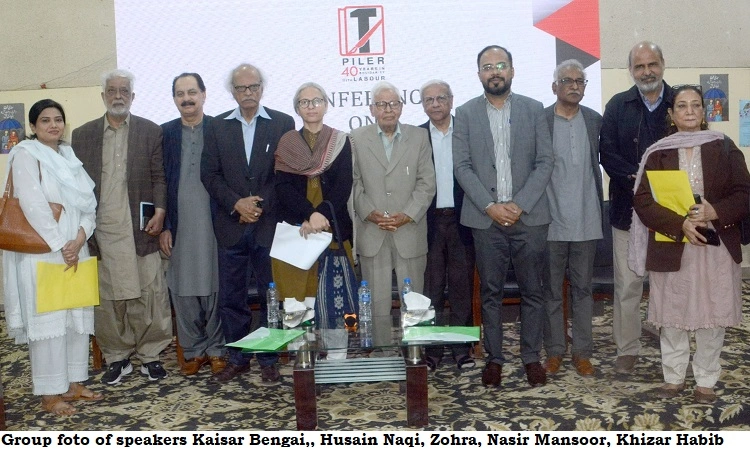
Others who spoke at the event include: Abiramy from Asia Floor Wage Alliance, labor rights expert Kiran Zubair, Zehra Khan of Home Based Women Workers Federation, Sessi deputy director Waseem Jamal, Liaquat Sahi of State Bank workers union, Zulfiqar Shah of Pakistan Accord, labor leader Habibuddin Junaidi and Abdul Latif Nizamani among others.
The following recommendations were presented at the conference:
- The minimum wage should be implemented immediately.
- Workers salaries should be paid through cheques.
- The factory inspection system should be improved, and a committee comprising trade unions, human rights organizations, labor support organizations, and employers should be formed to monitor inspections.
- International brands should ensure that their suppliers comply with labor-related laws.
- An economist should be included in the Wage Board as an advisor for determining the minimum wage.
- Freedom to form trade unions, as guaranteed by the Constitution, should be ensured.
- Government institutions should be made responsible for enforcing labor-related laws.