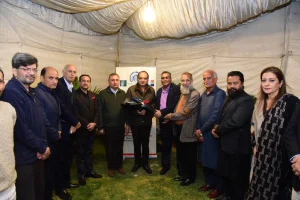
Baldia Town Factory Fire anniversary: Labor Rights Advocates Demand Systemic Reforms as Worker Safety Crisis Persists
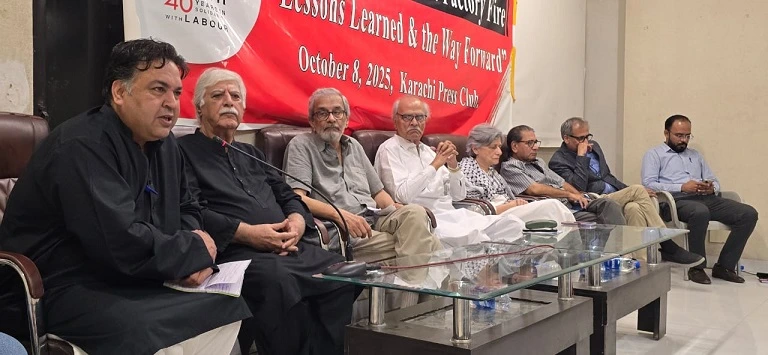
Baldia Town Factory Fire anniversary: Labor Rights Advocates Demand Systemic Reforms as Worker Safety Crisis Persists
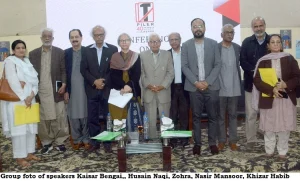
KARACHI, October 8 — Thirteen years after the catastrophic Baldia Town factory fire that claimed the lives of 260 garment workers, labor rights activists, legal experts, trade unionists, journalists, and victims’ families gathered at the Karachi Press Club on Wednesday to commemorate the tragedy and renew their call for systemic labor reforms and stronger worker protections in Pakistan.
The seminar, organized by the Pakistan Institute of Labour Education and Research (PILER), revisited one of Pakistan’s deadliest industrial disasters and highlighted both the achievements and persistent failures in ensuring workplace safety across the country.
PILER’s Continuing Fight for Justice and Compensation
Opening the seminar, Abbas Haider, Joint Director of PILER, underscored the organization’s central role in advocating for justice and compensation in the aftermath of the 2012 tragedy.
“PILER has played a crucial role in the Baldia Factory case,” Haider said. “This was not an accident—it was a crime of negligence that demanded accountability.”
Haider recalled that under the leadership of PILER’s late founder Karamat Ali, the organization successfully negotiated with German retailer KiK Textilien, the main buyer from Ali Enterprises, securing an initial $1 million in immediate relief in December 2012.
Through sustained international advocacy, PILER and partner organizations achieved a landmark agreement in September 2016, when KiK provided an additional $5.15 million in long-term compensation via the International Labour Organization (ILO).
Despite this progress, Haider warned that many structural problems remain unresolved.
“We see legislation, but no implementation,” he said. “Factory owners continue to operate with minimal oversight. We must raise our voices not just for compensation—but for safe workplaces and the dignity of labor.”
Pakistan Accord: A Model for Worker Safety
Zulfiqar Shah, head of the Pakistan Accord on Health and Safety in the Textile and Garment Industry, discussed how lessons from Baldia and Bangladesh’s Rana Plaza collapse (2013) inspired the creation of an independent inspection and monitoring system.
Since January 2023, Shah reported, the Pakistan Accord has deployed 40 engineers to inspect factories nationwide, producing 900 inspection reports and training over 100,000 workers—a significant milestone in an industry employing roughly 600,000 people. The Accord has also processed 150 formal complaints through its grievance mechanism.
He proposed the creation of a permanent online memorial on the Pakistan Accord’s website to honor the Baldia victims, inviting their families to collaborate on the project.
Legal Milestones and Ongoing Challenges
Prominent lawyer Faisal Siddiqui, who led the Baldia Factory case, described the fire as “a mass murder caused by corporate greed and systemic failure.”
“In the history of capitalism, no such large number of people were killed in a fire. This was our 9/11—Pakistan’s 9/11,” Siddiqui declared.
Siddiqui outlined several key achievements emerging from the Baldia case:
-
Sindh’s 1934 Factories Act was replaced with updated health and safety laws in 2017.
-
Germany’s Supply Chain Due Diligence Law now binds international buyers to ensure worker safety at supplier factories.
-
Pakistan’s garment sector has become significantly safer, with improved compliance compared to Bangladesh.
-
The ILO-mandated compensation exceeded $6 million, while local courts ordered the confiscation of Rs 50 million from factory owners.
“No such industrial tragedy has occurred in Pakistan since 2012. That is because of your struggle,” Siddiqui told the victims’ families. “You saved lives through your persistence.”
He cautioned, however, that a recent private insurance settlement made without the victims’ consent is under challenge, with complaints lodged at the ILO in Geneva and petitions being prepared for the Supreme Court. He also dismissed earlier claims of terrorism involvement in the fire as politically motivated fabrications.
“Justice comes from solidarity,” Siddiqui said. “When people stand united, even the judge will listen.”
Judicial Reflections on Accountability
Justice (Retd.) Maqbool Baqar, who presided over the Baldia case, gave a powerful reflection on the conditions inside the factory.
“The factory was like a prison,” he said. “There were no fire exits, no emergency routes, and no windows for ventilation. The entire system—from factory owners to inspectors—failed the workers.”
Justice Baqar’s rulings during the case led to several precedents:
-
DNA identification of victims to ensure transparent compensation.
-
Creation of a Compensation Commission to oversee disbursements.
-
Court-ordered confiscation of Rs 50 million from the factory’s proprietors.
He commended the families of victims for their perseverance, especially Saeeda Khatoon, who lost her son in the fire and became the symbol of the movement.
“The struggle of these families should be documented and taught worldwide,” he said. “Law may be slow, but it delivers permanent justice.”
Voices from Civil Society and Media
Speakers including journalist Mehnaz Rehman, trade unionist Qamar ul Hasan, Karachi Union of Journalists leader Tahir Hasan Khan, political veteran Habibuddin Junaidi, and Nazia, representing victims’ families, also addressed the gathering, calling for an end to exploitative labor practices and greater inclusion of workers in industrial policymaking.
Recommendations and the Way Forward
The seminar concluded with a series of policy recommendations aimed at preventing future industrial tragedies and strengthening labor rights enforcement:
-
Strengthen health and safety protocols and enhance inspection mechanisms.
-
Increase the number of labor inspectors to ensure effective compliance.
-
Declare September 11—the date of the Baldia tragedy—as National Occupational Safety and Health Day.
-
Guarantee workers’ right to unionize freely and without intimidation.
-
Address economic inequality by ensuring fair wages, gratuity, and health coverage—not charity.
-
Reform labor courts to ensure impartiality and accessibility for workers.