Pakistan Will Never Submit to Indian Hegemony, Says DG ISPR

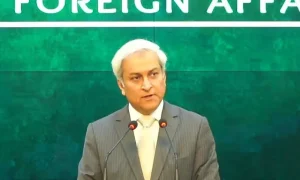
Gen Ahmed Sharif Chaudhry DG ISPR
Islamabad, May 18: Director General of Inter-Services Public Relations (ISPR) Lt Gen Ahmed Sharif Chaudhry has asserted that Pakistan will never yield to Indian hegemony, emphasizing the country’s resolve amid a fragile ceasefire between the two nuclear-armed neighbours.
In an interview with Anadolu Agency, Lt Gen Chaudhry stated, “The truth is that India is not the US, and Pakistan is not Afghanistan. India is not Israel, and Pakistan is not Palestine. Pakistan will never be deterred. It can never be coerced.”
“We will never bow down to Indian hegemony. The sooner they realize this, the better it will be for regional peace and the world,” he added.
The military spokesperson accused India of using internal issues—such as terrorism, extremism, and communal strife—to deflect attention from its domestic crises. He claimed that New Delhi’s crackdown on minority groups, including Muslims and Sikhs, was exacerbating unrest within India.
Ceasefire and Diplomatic Efforts
The DG ISPR reiterated Pakistan’s commitment to peace, stating, “We are not a violent nation; we are a serious nation. Our first priority is peace.” His remarks followed a recent escalation triggered by India’s unsubstantiated allegations linking Pakistan to last month’s deadly attack in occupied Kashmir’s Pahalgam. Islamabad denied involvement and demanded an impartial investigation.
Tensions escalated into military clashes, prompting U.S. mediation to secure a ceasefire. Lt Gen Chaudhry revealed that the Indian defense ministry had “personally requested a ceasefire,” though it remained unclear whether the request was directed at Washington or Islamabad.
“We desire peace and stability, so we said, why not?” he told PTV News, praising Pakistani diplomats for their “tremendous work” in engaging the international community.
Military Escalation and Pakistan’s Response
The DG ISPR recounted the events of May 6-7, when India conducted airstrikes in Punjab and Azad Kashmir, killing over 30 civilians. Pakistan retaliated by downing five Indian jets and intercepting multiple drones.
On May 9, India struck Pakistani airbases, prompting Islamabad to launch “Operation Bunyanum Marsoos,” targeting Indian military installations with precision. “The nation and the Pakistan armed forces stood united like an unbreakable wall,” he said.
Despite further Indian missile strikes on May 9-10, Pakistan responded with “utmost responsibility,” hitting only military objectives. “Not a single civilian target was harmed; it was an appropriate, just, and balanced response,” he emphasized.
Criticism of India’s Narrative
Lt Gen Chaudhry accused India of pushing a “false narrative” to obscure the truth behind recent tensions. He pointed out that while Indian media immediately blamed Pakistan for the Pahalgam attack, New Delhi later admitted that investigations were ongoing.
“Where is the wisdom in making allegations without investigation and evidence?” he questioned, reiterating Pakistan’s offer for a neutral probe. “India rejected a logical, neutral investigation because it fears exposure of the truth.”
The military spokesman reaffirmed Pakistan’s stance as a responsible state committed to peace but warned that any aggression would be met with a firm and measured response.