10.3% of children aged 5-17 years in Sindh are engaged in child labour
Sindh Government and UNICEF Launch the Sindh Child Labour Survey Report 2023–24
Sindh Government and UNICEF Launch the Sindh Child Labour Survey Report 2023–24
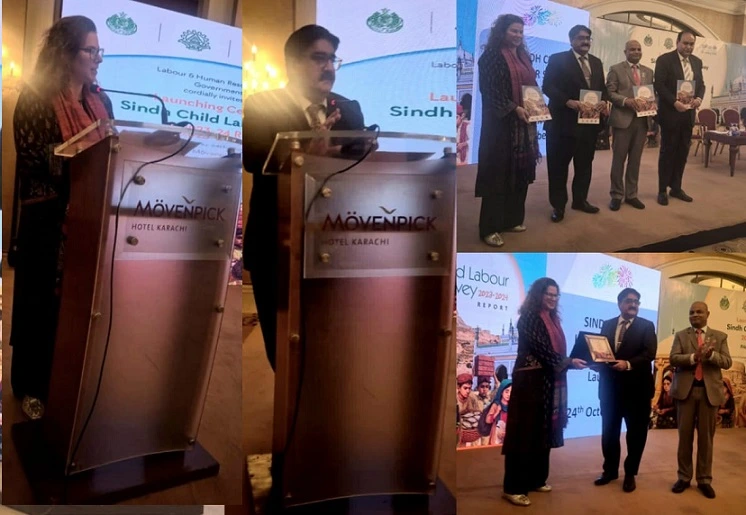
Karachi, October 24, 2025-The Labour and Human Resources Department, Government of Sindh, in collaboration with UNICEF, officially launched the Sindh Child Labour Survey (SCLS) 2023–24 at an event held in Karachi today.
The ceremony was graced by Mr. Asadullah Abro, Secretary, Labour, Human Resources & Social Protection Department, Government of Sindh, as Chief Guest, along with Mr. Prem Bahadur Chand, representing UNICEF. The landmark survey, conducted by the Department with technical support from UNICEF and the Sindh Bureau of Statistics, reveals that 10.3% of children aged 5-17 years in Sindh are engaged in child labour.
This survey the first in nearly three decades provides vital evidence to guide stronger policies and interventions for eliminating child labour. It highlights the living conditions, educational status, and work responsibilities of children across all 29 districts of Sindh.
Notably, the prevalence of child labour in Sindh has declined by nearly 50% since the last survey in 1996 (20.6%), reflecting significant progress through better legislation, enforcement, and child protection initiatives.
Key Findings of the Sindh Child Labour Survey
Prevalence: 10.3% of children aged 5-17 years are engaged in child labour, with a marked gender gap – 13.7% of boys and 6.6% of girls.
Regional Differences: Highest rates are in Sujawal (35.1%) and Tharparkar (25.6%), while Malir (2.7%) and Karachi South (3.0%) report the lowest.
Hazardous Work: 50.4% of working children aged 10-17 are exposed to hazardous conditions, including carrying heavy loads (29.8%), exposure to extreme temperatures (28.1%), and workplace abuse (17.5%).
Education Impact: Only 41.2% of children in labour attend school, compared to 69.9% of non-working children. Attendance drops further with age-just 29.1% of working adolescents (14-17 years) remain in school.
Sectors of Employment: Most child labour occurs in agriculture (65.1%), followed by manufacturing (12.4%) and wholesale/retail trade (10.8%).
Economic Factors: Poverty is a major driver-33.7% of the poorest households have a child in labour, compared to 3.8% among the wealthiest. Households receiving BISP support or facing economic shocks show higher child labour rates.
Official Remarks
Speaking at the launch, Mr. Asadullah Abro, Secretary, Labour and Human Resources, said:
“The findings of this survey are a stark reminder of the work that lies ahead of us. We cannot accept a future where our children are deprived of education and childhood. The Government of Sindh is committed to using this evidence to strengthen the enforcement of the Sindh Prohibition of Employment of Children Act, 2017, and to design targeted interventions that address the root causes of this issue, particularly in high-burden districts.”
Ms. Jennifer Melton, Chief of Child Protection, UNICEF, emphasized the significance of the survey in shaping child protection policy and inter-sectoral collaboration across Sindh.
“Every child deserves a childhood filled with learning, play, and opportunity-not labour,” said Ms. Melton. “This survey gives us the data and insight needed to act decisively. UNICEF remains committed to supporting the Government of Sindh to turn this evidence into stronger systems, better services, and brighter futures for all children.”
Mr. Zulfikar Ali Nizamani, Director General, Labour Department, also appreciated the government-UNICEF partnership and reaffirmed the Department’s commitment to ending child labour through enforcement and awareness initiatives.
Mr. Reejhu Mal S. Sajnani, Project Coordinator, and Mr. Izat Chachar, Survey Coordinator, presented the key findings, emphasizing the importance of government, development partners, and communities working together to eradicate child labour.
The survey also revealed that 44.3% of parents allow children to work to supplement family income, while 43.5% of working children reported fatigue or injury from work-related tasks.